This year, our university once again joined Girls’ Day, the nationwide career orientation event initiated by the Association of Hungarian Women in Science, aimed at promoting STEM-related professions among female students. We welcomed upper primary and secondary school girls to our faculties, laboratories, and research centers, where they were introduced to the worlds of science, technology, and IT through interactive programs led by our experts.
The program focused on hands-on experience, interactive learning, and the presentation of female role models. Every year, the organizers aim to demonstrate that engineering and natural science careers are creative, socially valuable, and offer excellent career opportunities for women as well.
Alba Regia Faculty
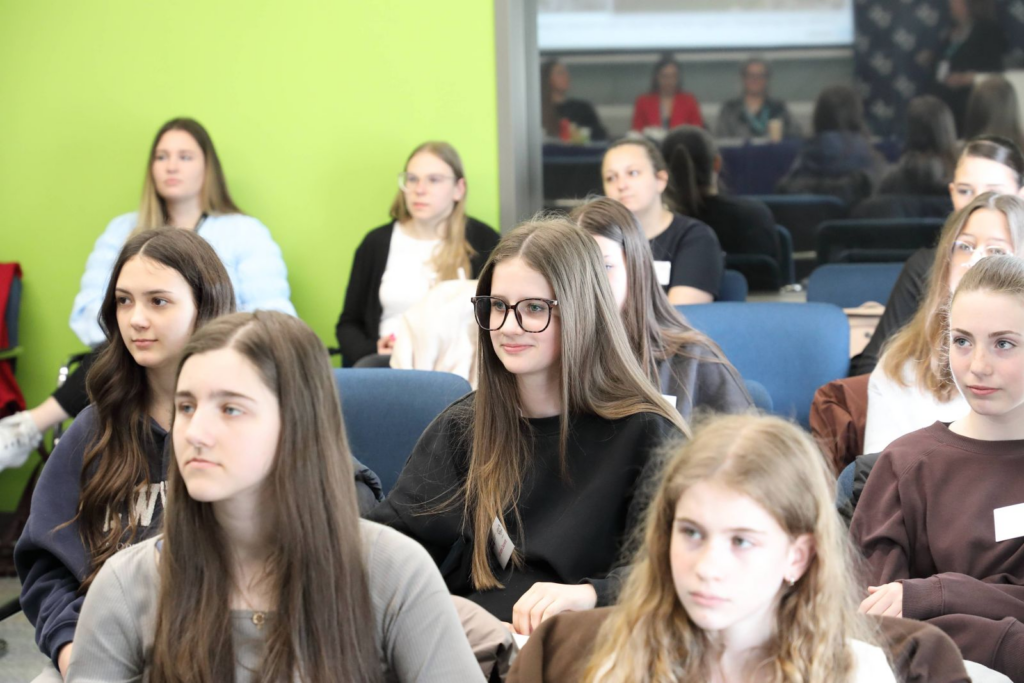
At the Alba Regia Faculty of Óbuda University, 24 female students participated in the “Create in the Present, Dream the Future!” program, where they explored seven professions — data scientist, materials engineer, mechanical engineer, environmental engineer, mechatronics engineer, software engineer, and electrical engineer — through presentations delivered by female professionals. The aim of the event was to showcase as many successful female career paths as possible within science, engineering, and economics.
The first presentation was held by students of the Sports Economics master’s program, who engaged participants with an interactive quiz. Among the university’s corporate partners, Arconic joined this year’s program and demonstrated manufacturing processes using impressive visual tools. Following the presentations, students visited the VR laboratory and robotics laboratory in groups, where they explored the university’s modern infrastructure and technologies. Organizers hope that the girls arriving from Székesfehérvár and the surrounding region enjoyed their experience and that many of them became interested in scientific, IT, economic, and engineering careers.
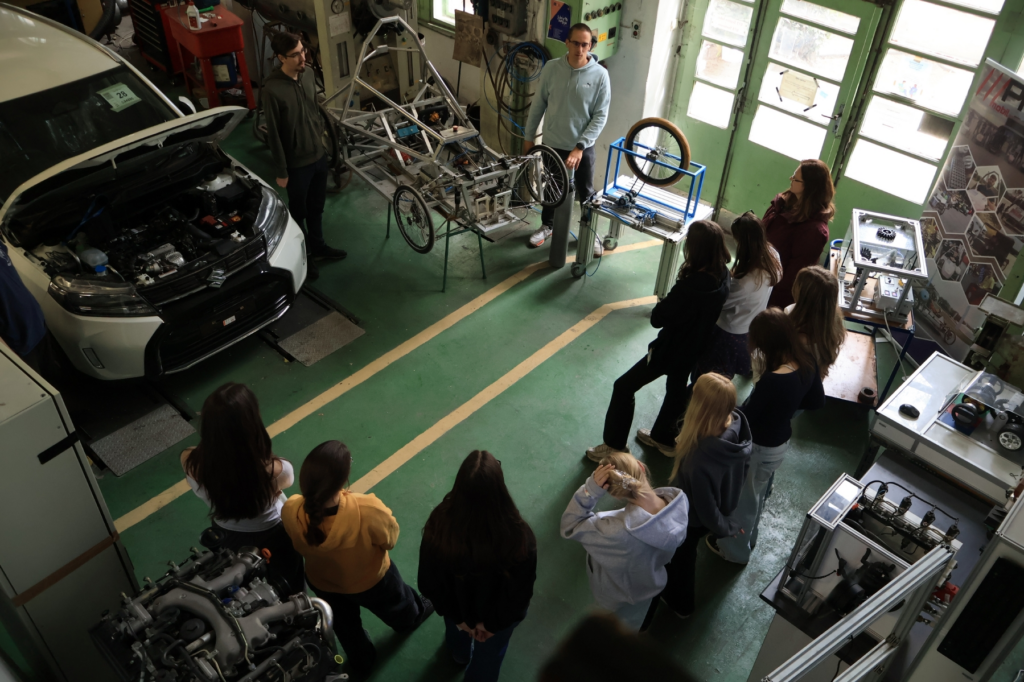
Donát Bánki Faculty of Mechanical and Safety Engineering
Girls’ Day also attracted significant interest at the Bánki Faculty. Participants attended numerous exciting technical presentations and experiments while gaining insight into what it is like to pursue and succeed in a technical career as a woman. The program provided an engaging introduction to the diversity of engineering fields and offered high school girls the opportunity to experience engineering thinking and practical technical work firsthand.
Participants attended fascinating engineering demonstrations and experiments while also meeting lecturers and university students who introduced various professional fields.
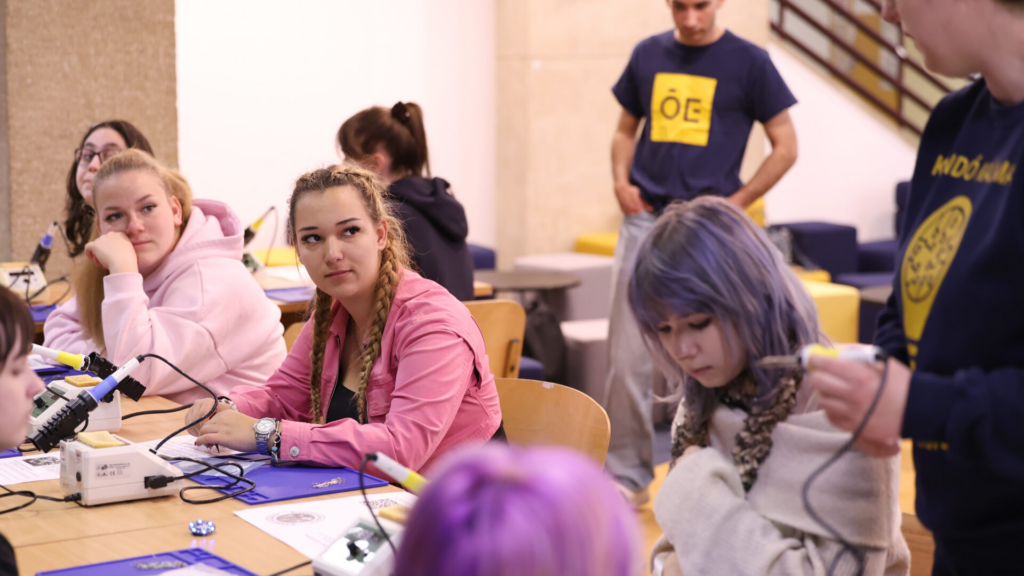
Kálmán Kandó Faculty of Electrical Engineering
An experience-rich Girls’ Day program took place at the Kandó Faculty, where participants explored the world of science in playful and visually engaging ways. During the morning, students created their own badges and attended exciting presentations on the relationship between nature and technology, symmetries, and one of the universe’s greatest mysteries: dark matter.
One of the highlights of the day was the high-voltage demonstration, where participants observed spectacular electrical phenomena up close. The program concluded with a special Japanese ikebana workshop, offering insight into the world of balance and harmony.
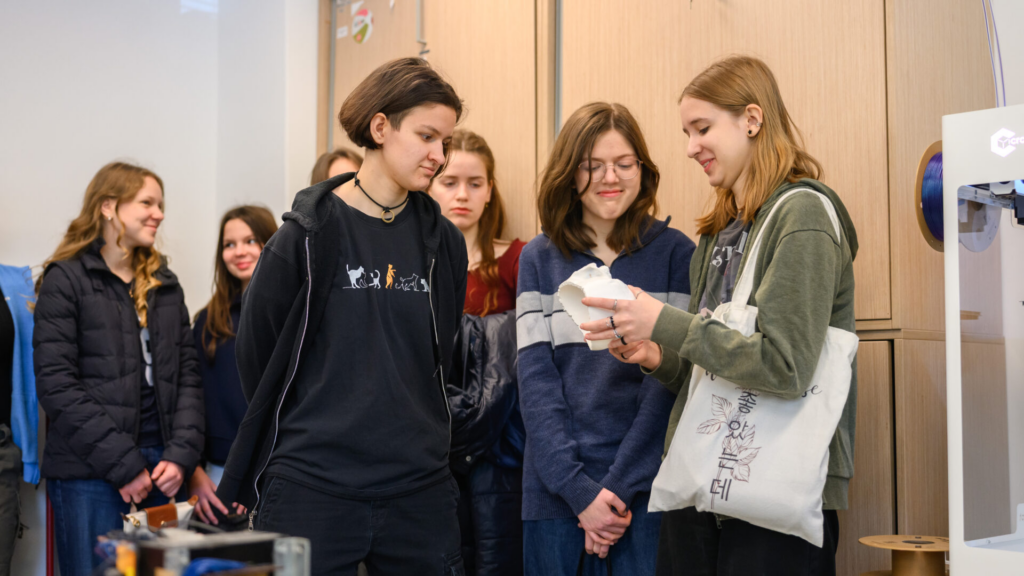
John von Neumann Faculty of Informatics
As part of the “Technology Discovery Day – 3D Printing, Biotechnology and AR/VR Experiences” program, participants gained comprehensive insight into cutting-edge technological solutions while acquiring active, experience-based knowledge.
The event was organized across three interconnected locations. The first stop introduced participants to the world of 3D printing, where they learned about the technology’s principles, operation, and practical applications. They were not merely observers but active participants in the process: through a collaborative 3D printing project, they experienced firsthand how a digital model becomes a tangible object.
The program continued in the BioTech laboratory, where the PathoVR project was presented. This innovative development applies virtual reality technology in medical and biotechnological fields, opening new perspectives for education and research. Participants gained insight into the project’s operation and significance.
Afterwards, the group visited the AR/VR Laboratory, where an equipment-based demonstration awaited them, including opportunities to test the showcased technologies themselves. Throughout the day, participants gained firsthand experience with virtual reality applications, including the PathoVR system and other innovative tools. The program provided an ideal opportunity for anyone wishing to explore and experience the technologies of the future in an inspiring university environment.
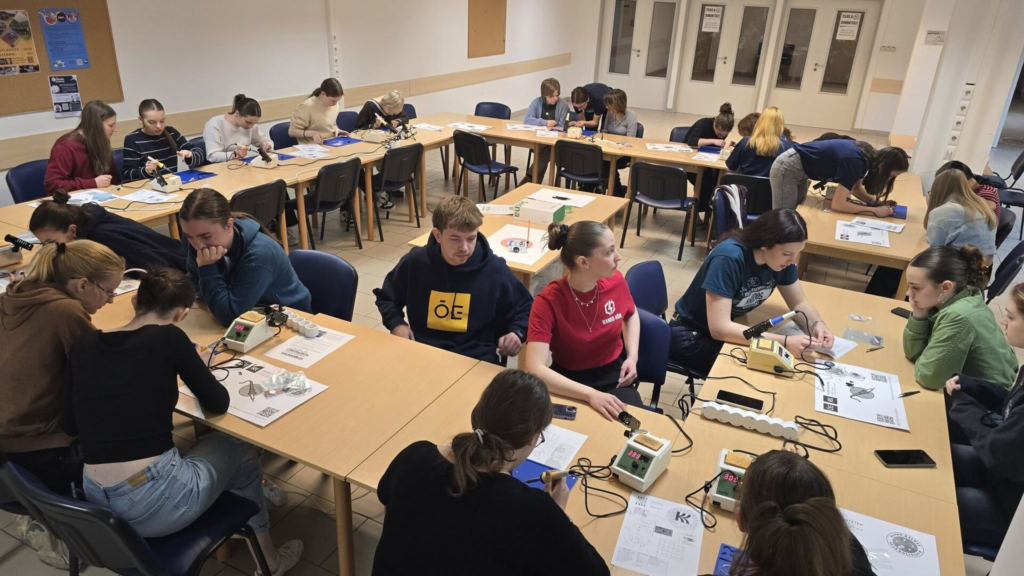
Rejtő Sándor Faculty of Light Industry and Environmental Engineering
The Doberdó campus opened its doors wide to the future generation of female engineers, who spent a truly inspiring morning with us in a direct and welcoming atmosphere.
The program began with an energetic Student Union presentation in the Schmalz Hall, where participants not only learned about student life, but also took part in quizzes and won exciting prizes. Creativity took center stage in the main hall, where visitors admired impressive project works, fashion illustrations, and clothing design exhibitions created by industrial product and design engineering students. The bravest participants also had the chance to try themselves in a creative fashion design workshop.
The excitement of engineering sciences came to life during the hydrology and hydraulics workshop, where spectacular systems were built using plastic tubes and syringes. During the day, participants also gained insight into the technological background of environmental protection, learning about the control systems of wastewater treatment and waste sorting facilities.
Laboratory visits included tours of the sewing workshop and manufacturing technology laboratory of the Institute of Product Design. The event concluded with a microscopic exploration, where participants discovered the hidden close-up world of paper and printing projected onto a smartboard.