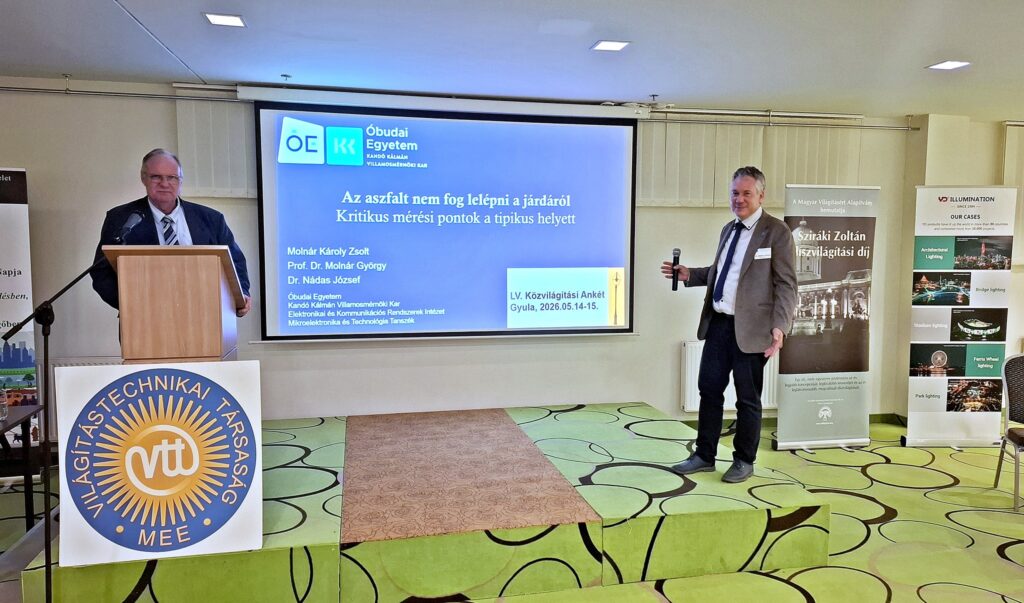
The future of smart urban infrastructure and sustainable mobility took center stage at the 55th Public Lighting Conference held in Gyula, Hungary, where researchers and lecturers from Obuda University presented their latest professional achievements. The event focused on energy-efficient LED public lighting systems, as well as intelligent urban technologies supported by artificial intelligence and sensor networks.
Obuda University was represented by presenter Károly Molnár together with researchers Prof. Dr. György Molnár and Dr. József Nádas. Their presentation, titled “The Asphalt Will Not Step Off the Sidewalk – Critical Measurement Points Instead of Typical Ones,” addressed the methodology of measuring pedestrian crossing illumination, with a strong emphasis on road safety and the protection of vulnerable road users.
The conference highlighted how modern public lighting systems now extend far beyond traditional photometric standards. Today’s advanced LED technologies can dynamically adapt to traffic density, weather conditions, and even the reflective properties of road surfaces. The integration of artificial intelligence and sensor-based systems is opening new opportunities for safer, more energy-efficient, and more sustainable urban mobility.
Within this rapidly evolving technological landscape, the proper illumination of pedestrian crossings has become increasingly important. While straight road sections are governed by well-established lighting standards, the planning and measurement of zebra crossing illumination remain underregulated and insufficiently standardized areas. The research presented by Obuda University offers a new approach by focusing on real-life traffic safety considerations that go beyond current minimum requirements.
The project demonstrates how engineering innovation, energy efficiency, and human-centered urban design can work together to create safer and more sustainable cities. Intelligent public lighting not only reduces energy consumption but also improves the safety, comfort, and overall quality of urban life.
Obuda University’s participation once again confirmed the institution’s leading role in shaping the future of smart city technologies and road safety solutions while actively contributing to sustainable urban development through research and innovation.